How Financial Institutions Are Automating KYB Onboarding at Scale
AI Will Have the Biggest Impact on KYB Over the Next Two Years. Here's What Compliance Teams Need to Get Right.
May 20, 2026
Dr. Philipp Eska
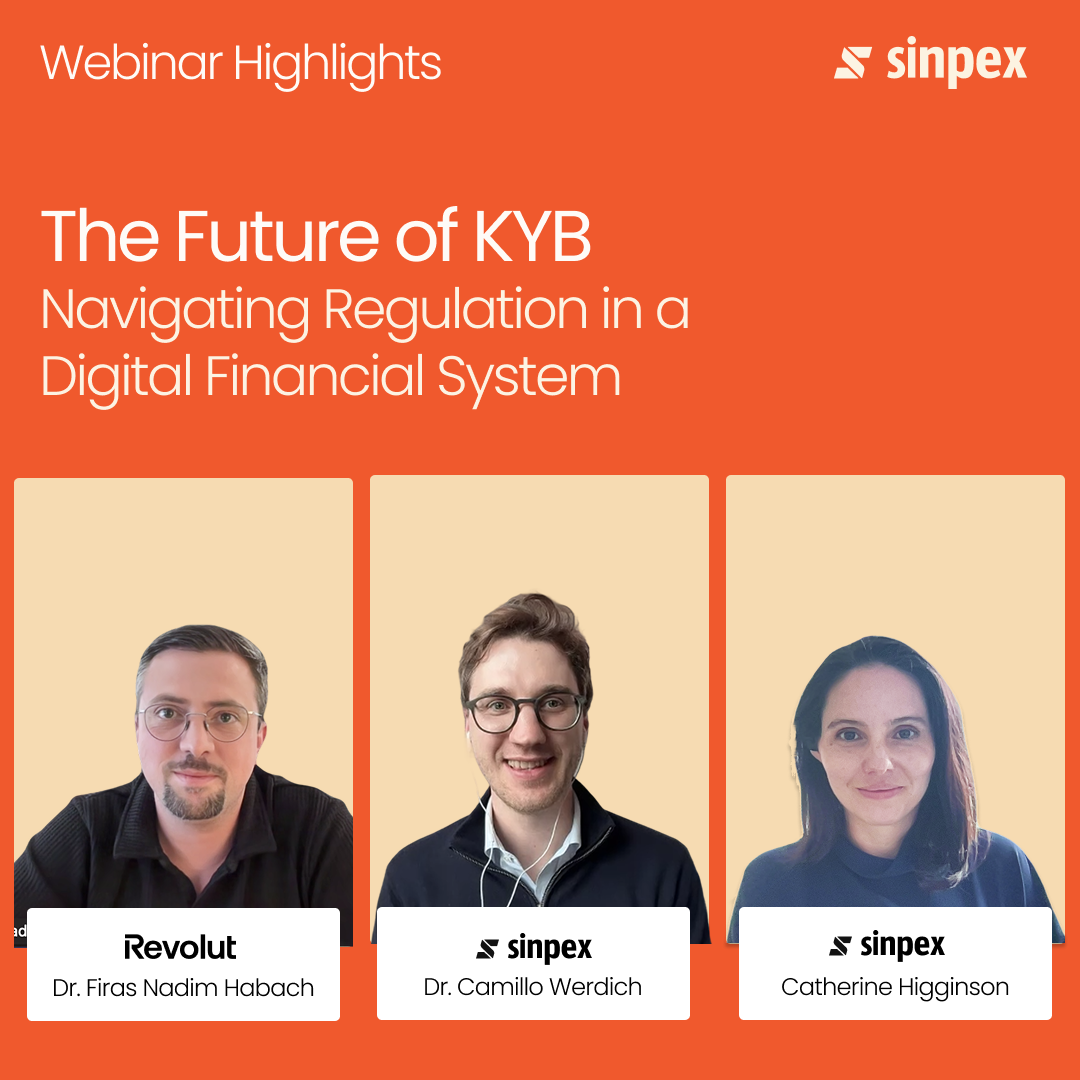
KYB teams across Europe are under pressure from every direction: increasing onboarding volume, more complex ownership structures, rising regulatory expectations, and compliance operations that still rely heavily on manual review.
For many institutions, onboarding a complex cross-border business customer still takes days. Ownership data arrives in PDFs, registry standards differ by jurisdiction, and analysts manually reconcile information across disconnected systems.
The result is not just slower onboarding. It is inconsistency, operational bottlenecks, and audit risk.
AI and automation are now changing that equation.
In a recent Sinpex webinar featuring Dr. Firas Habach, Money Laundering Reporting Officer for Switzerland at Revolut, and Dr. Camillo Werdich, CEO and founder of Sinpex, 64% of compliance professionals identified AI and automation as the biggest upcoming driver of change in KYB over the next two years. But where does automation actually improve KYB operations — and where are the limits?
Manual KYB was designed for lower volumes, simpler ownership structures, and fewer jurisdictions. None of those conditions exist anymore.
The core failure mode is inconsistency. When 36 compliance officers were asked to review the same transaction monitoring alert in a controlled study, they produced 14 different responses. That is not a skills problem. It is a structural one: without standardized data inputs and consistent workflows, every review depends on individual judgment — and individual judgment varies.
At scale, that variation creates three compounding problems:
Understanding where manual processes fail is the prerequisite for knowing where automation helps. The bottlenecks are consistent across institutions.
Complex ownership structures
Layered ownership across multiple jurisdictions is the single most time-consuming element of KYB. Identifying beneficial owners, calculating voting rights, and mapping control chains requires pulling information from sources that are inconsistent, incomplete, or entirely unavailable in structured form.
Unstructured registry data
Germany has shareholder lists. The US has no publicly available shareholder information at all. Most jurisdictions fall somewhere between those extremes. Ownership documentation typically arrives as PDFs, in multiple languages, from registries with no API access.
Sequential manual reviews
In most institutions, KYB review steps are sequential: one analyst collects, another extracts, a third reviews, a fourth quality-checks. Each handoff adds time and introduces the possibility of inconsistency.
Cross-border onboarding requirements
Document validity periods, UBO disclosure thresholds, and acceptable evidence types differ by jurisdiction. Compliance teams operating across borders must manage these variations manually unless they have systems that handle jurisdictional logic automatically.
AI does not solve all KYB problems. It solves specific, well-defined ones — and it solves them well.
AI-powered document extraction
LLMs extract structured data from unstructured documents: PDFs, scanned shareholder lists, registry outputs in foreign languages. For each document, AI identifies first name, last name, title, date of birth, nationality, capital share percentage, and voting rights — consistently, without an analyst manually reading and transcribing.
As Dr. Camillo Werdich explained: "The complexity comes from the fact that data is usually not accessible in a structured way. In Germany you have shareholder lists. In the US you have no shareholder information publicly available at all. In reality, this information comes in as a PDF, which is very unstructured in most cases."
Automated UBO identification
Beneficial ownership resolution — tracing ownership chains through multiple layers to identify natural persons with control above threshold — is now automatable for the majority of cases. AI traverses ownership structures, flags incomplete chains, and identifies where human review is genuinely needed, rather than applying analyst time uniformly across all cases.
For a detailed walkthrough, see our post From Hours to Minutes: How to Automate UBO Identification in Your KYC Onboarding.
Cross-validation across data sources
Single-source extraction is not enough for compliance purposes. AI systems that cross-validate extracted data — confirming that an address, name, or shareholding percentage is consistent across all submitted documents and available registry data — remove the dependency on analysts catching discrepancies manually. Inconsistencies are surfaced automatically, with a reference to the exact documents and fields where the conflict appears.
Faster onboarding workflows
The combined effect of automated extraction and cross-validation is a significant reduction in analyst time per case. Tasks that previously required hours of manual work — collecting documents, reading PDFs, formatting data, reconciling sources — are completed in minutes. Analysts focus on exception handling and judgment calls, not data entry.
Most AI content focuses on speed. In compliance, speed is secondary. The primary requirement is defensibility.
When a regulator asks how you reached a KYB decision, the answer must trace back to a primary source: a commercial registry document, an official shareholder list, a verified customer submission. That path must be documented, timestamped, and reproducible.
As Dr. Werdich put it: "What really matters in compliance is evidence. You want a clear path towards the source of information. It can be the customer. But it can also be a document collected from the commercial registry directly."
This is where many technology vendors fall short. A large number of KYB platforms aggregate and repackage data from multiple third-party providers. The output looks comprehensive. But when an auditor asks for the source, the answer is often a chain of intermediaries with no clear path to a primary source. "Everyone repackages data from the other one," Werdich noted, "and at the end, nobody knows what's true."
Aggregated data creates the appearance of completeness while undermining the auditability that compliance requires. Evidence-based automation — where every extracted data point links directly to its source document — is the standard regulators are increasingly expecting.
For an overview of what EU AML requirements mean for compliance programs, see EU AML 2027: What Compliance Teams Need to Do Right Now.
Perpetual KYB replaces fixed-interval re-KYC with continuous, event-triggered monitoring. Instead of reviewing every business customer on a two- or three-year schedule, institutions monitor relevant data sources continuously and trigger a review only when something material changes.
Continuous monitoring vs periodic review
Registry connectivity
Perpetual KYB depends on direct connections to commercial registries, UBO registers, and sanctions databases. Without these connections, monitoring is only as good as the last manual review.
Event-triggered compliance reviews
A change in beneficial ownership, a new sanctions hit, a shift in business activity — these are the triggers that matter. A well-configured perpetual KYB system detects these events automatically and routes affected cases for review.
Data infrastructure limitations
The blocker for most institutions is not the monitoring technology itself. It is the underlying data infrastructure. If a core banking system cannot ingest structured data from external APIs in a meaningful way, automated monitoring cannot function. The first step toward perpetual KYB is often a data infrastructure assessment, not a technology procurement.
When evaluating KYB technology, the most common mistake is conflating a polished demo with compliance-grade performance. The right questions focus on evidence, not features.
Questions to ask before signing a contract:
How does AI automate KYB onboarding?
AI automates the data extraction and validation steps that currently consume most analyst time. This includes extracting structured data from unstructured documents, identifying beneficial owners and calculating shareholding percentages, cross-validating data across multiple sources, and flagging inconsistencies for human review. The compliance decision itself remains with the analyst.
Can AI identify UBOs automatically?
Yes, for the majority of cases. AI reads ownership documentation, extracts shareholder data, traces ownership chains through multiple layers, and identifies natural persons with control above threshold. Complex or contested ownership structures still require human judgment, but AI handles the data collection and structuring step that currently accounts for most of the time.
What is perpetual KYB?
Perpetual KYB is a monitoring approach that replaces fixed-interval re-KYC reviews with continuous, event-triggered oversight. Systems monitor relevant data sources continuously — registries, sanctions lists, adverse media — and trigger a compliance review only when something material changes. It requires direct registry connectivity and a configurable risk model.
Does AI replace compliance officers in KYB?
No. AI handles the structured, extractable elements: document extraction, data structuring, cross-validation, and monitoring. Risk-based judgment, adverse media interpretation, and final compliance decisions remain human responsibilities. The practical effect is that compliance officers spend less time on data entry and more time on judgment calls.
What makes AI-generated KYB decisions audit-ready?
Auditability depends on evidence traceability. An AI-generated KYB decision is audit-ready when every extracted data point links directly to its source document or registry record, when the decision trail is documented automatically, and when the system can reproduce the basis for a decision at any point in the future. Decisions based on aggregated third-party data without a clear source path are not audit-ready.
Institutions scaling KYB across jurisdictions need more than faster workflows. They need structured evidence, traceable data sources, and automation that stands up to regulatory scrutiny.
See how Sinpex automates KYB onboarding, UBO identification, and perpetual monitoring across jurisdictions:
If you want to see how this works in practice for your institution, book a conversation with the Sinpex team.
.png)
CFO | Sinpex

Philipp spent more than four years as a Consultant at McKinsey before moving into M&A and corporate development, leading transactions at Zahneins. He brings that mix of strategic and financial rigour to Sinpex as CFO, helping the company scale in the RegTech space.
