From Hours to Minutes: How to Automate UBO Identification in Your KYC Onboarding
A practical guide for compliance teams: how to fully automate UBO identification across multi-layer corporate structures. Reduce manual investigation from days to minutes in your KYB onboarding.
March 16, 2026
Fabian Frieß
Picture this: a new corporate client has just submitted their onboarding application. Your KYC analyst opens the case, looks at the ownership structure, and sees what they've come to dread: a multi-layer holding structure spanning three jurisdictions. What should be a straightforward verification step turns into a multi-day investigation: downloading shareholder lists, cross-referencing commercial register documents, tracing ownership layer by layer until every beneficial owner above the regulatory threshold is identified and verified.
Meanwhile, your Sales team is fielding calls from the prospect asking when they can get started. And your competitor? They're already onboarding the client's sister company with a two-day turnaround.
This is the reality for compliance teams relying on manual UBO identification. And it's costing businesses far more than just time.
The Problem: Manual UBO Research Is Your Onboarding Bottleneck
Identifying Ultimate Beneficial Owners (UBOs), the natural persons who ultimately own or control a company, is a legal requirement under AML regulations across Europe and beyond. Regulatory pressure is only increasing: the latest AML, KYC, and KYB trends show that compliance programs are shifting from static checklists to continuous, intelligence-led systems, which makes having a fast, reliable UBO process more important than ever.
But the process of actually finding those UBOs is one of the most time-consuming, error-prone steps in any KYC workflow.
Here's why: a single corporate client can have an ownership structure with three, four, or even five layers of holding companies, each registered in a different jurisdiction. For every layer, an analyst must manually locate and download the relevant register documents, extract shareholder information, calculate ownership percentages, and decide whether to drill further. If the sources conflict or a document is unavailable, the process stalls entirely.
The result? What should take 30 minutes can easily consume four to eight hours — and that's for a reasonably straightforward case. Complex structures can take days. Your analysts can't tell you in advance which category a new case falls into, making it nearly impossible to commit to reliable onboarding timelines.
For CFOs and VP Operations, the downstream impact is clear: high onboarding cycle times, unpredictable SLAs, and — critically — prospects who simply don't wait. High onboarding abandonment rates destroying your top line aren't a sales problem. They're often a UBO research problem hiding inside your KYC process.
When This Problem Occurs
The friction hits at the worst possible time: during initial onboarding, when a new customer's first impression of your organization is being formed.
Your analyst receives a new case. The entity has a legitimate, complex ownership structure spanning multiple countries and legal forms. The analyst begins the familiar sequence: find the correct commercial registry, navigate the interface, pay for the document, wait for delivery, extract the shareholder data, then repeat for the next layer. If they hit a dead end (e.g. no document available, extraction fails, data conflicts with another source) the case stalls entirely.
This isn't the exception. For B2B financial services and regulated companies onboarding corporate clients, complex ownership structures are routine. Every delay compounds: the analyst's queue backs up, other cases wait, and the prospect who submitted their application on Monday still hasn't heard anything by Thursday.
The business consequences are twofold. First, prospects who were initially enthusiastic drop off, choosing a competitor whose onboarding moved faster. Second, the customers who do push through arrive frustrated, and that frustration shapes how they experience your entire relationship from day one.
How Sinpex's UBO Drilldown Solves This
Sinpex's UBO Drilldown is a purpose-built automation of the entire beneficial ownership identification process, not a tool that helps analysts search faster, but a system that conducts the investigation for them.
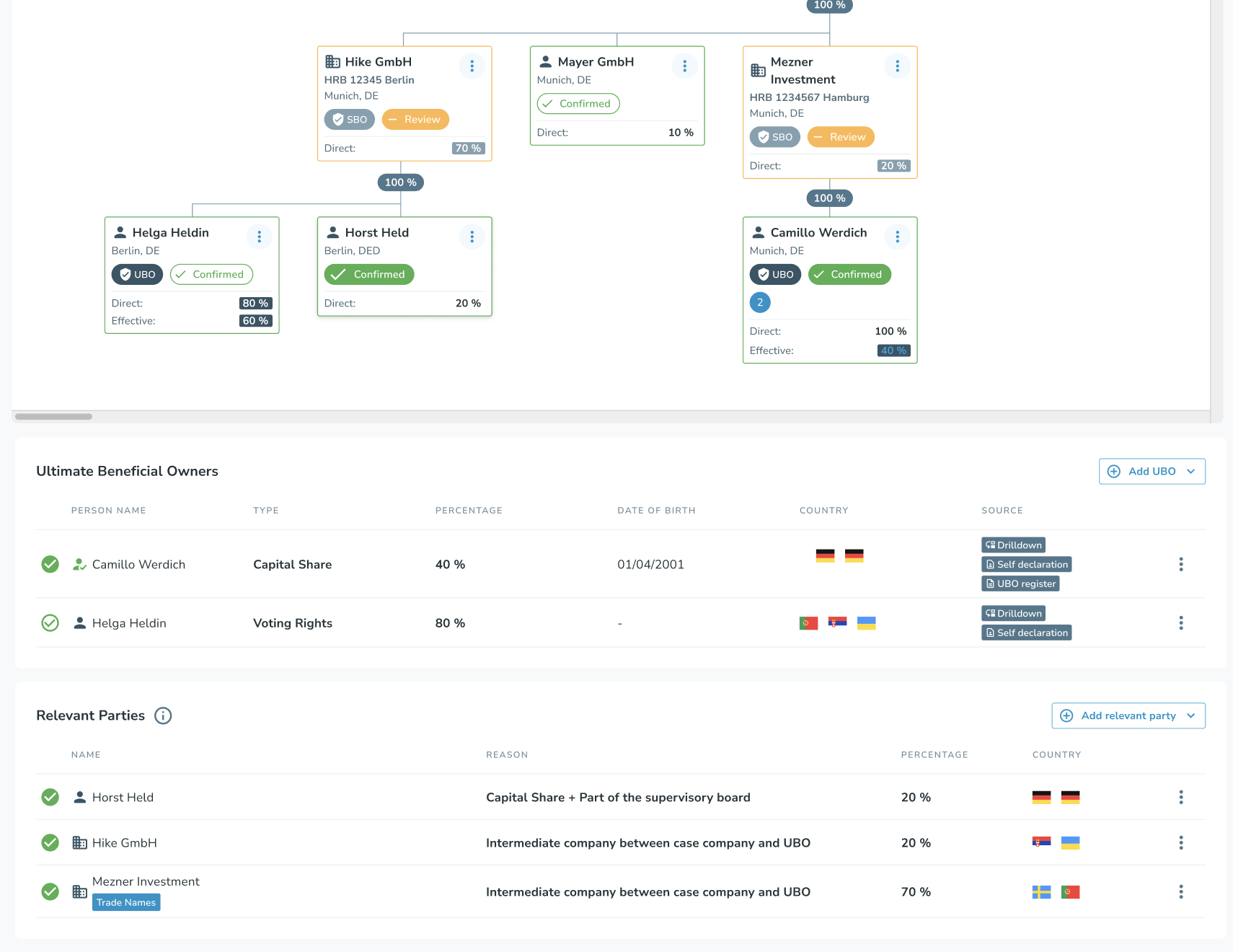
Here's how it works: when a new case is initiated, the UBO Drilldown starts automatically for the root company. The system purchases the required official documents, such as shareholder lists, register reports, and uses AI to extract ownership data and construct a visual ownership tree in real time. It then recurses: for every corporate shareholder discovered, it repeats the process layer by layer until it reaches the natural persons who qualify as UBOs under the applicable thresholds (25% for the first ownership layer, 50% for all subsequent layers).
As it works, the system populates a structured task list. Most tasks are handled automatically: document purchase, data extraction, cross-source verification. The system only surfaces a task to the analyst when genuinely human judgment is needed, for example, when a document is unavailable and an alternative source must be provided, or when two sources contain conflicting data.
Every entity in the ownership tree carries a clear status: in progress, review needed, machine confirmed, or human confirmed. Analysts don't need to track progress manually. The system shows them exactly where things stand and what, if anything, requires their attention. And if they need to intervene (editing a stakeholder, adding a missing entity, or overriding a machine suggestion) full control is available at every step.
With the UBO Drilldown handling routine investigation, your compliance team works differently and better.
The most immediate change is capacity. An analyst who previously spent four to eight hours on a single complex case can now review the system's output in fifteen minutes, spending their time on genuine judgment calls rather than registry navigation. The same team processes significantly more cases per day without working longer hours. Your onboarding queue moves. This matters especially now: with AML review cycles shortening under the EU's new regulatory framework, lean compliance teams need every efficiency gain they can get.
The second change is predictability. Because the system handles the variable, time-consuming core of UBO research automatically, onboarding cycle times stop fluctuating unpredictably. You can commit to SLAs and actually keep them. Sales teams can make promises to prospects that your compliance function can deliver on.
The third change is accuracy. Manual UBO research is vulnerable to human error, such as missed ownership layers, misread percentages, overlooked documents. The UBO Drilldown cross-references multiple sources and only marks entities as confirmed when independent verification exists. Where it can't confirm with two sources, it flags the gap and requests human review rather than silently passing through incomplete data.
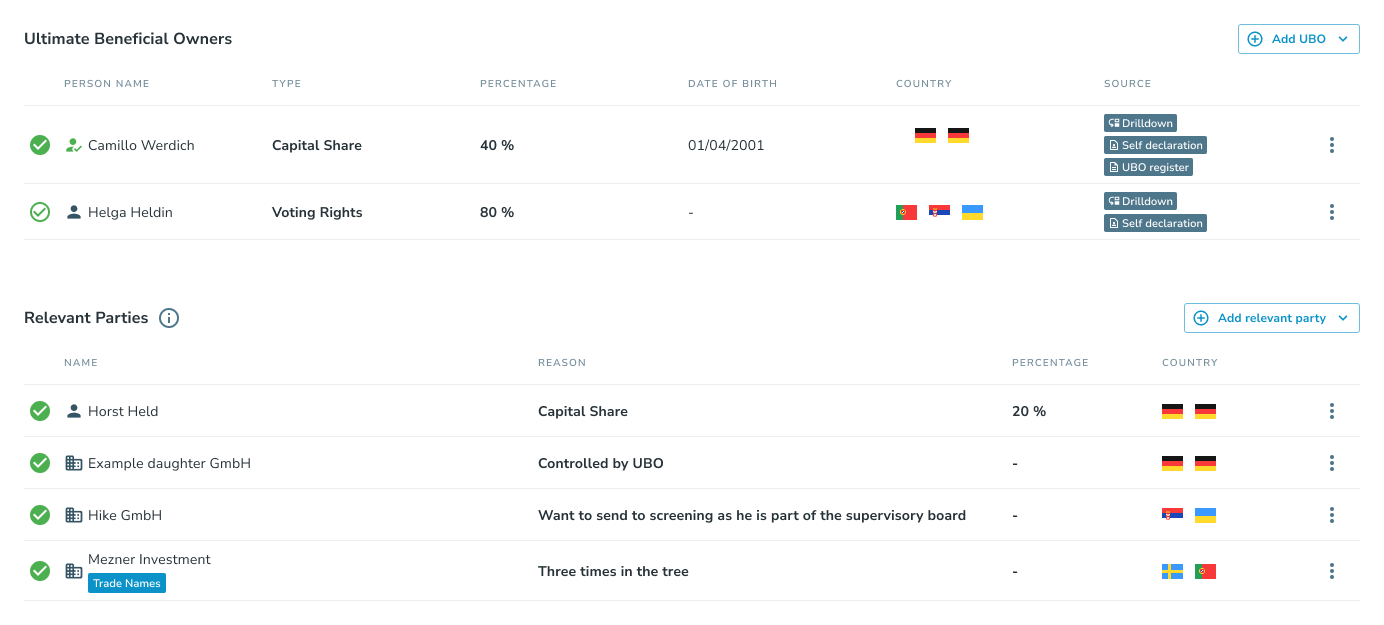
And everything is traceable. Each data point links back to its source document. Every decision (automated or human) is logged. When an auditor asks how you identified a particular UBO, the answer is a click away.
The Real Impact
The business case for automating UBO identification comes down to two numbers that matter to every CFO and operations leader: conversion rate and cost per onboarded customer.
When onboarding cycles shorten from weeks to days, the prospects who were abandoning midway through stay. The revenue that was evaporating, e.g. leads your Sales team won but Compliance couldn't activate fast enough, is recovered. Sinpex customers report that human effort in the UBO identification process alone reduces by a factor of 5 to 10x after implementing the UBO Drilldown. This case study on AI-powered KYB automation shows what that kind of efficiency gain looks like in practice.
At the same time, the cost structure changes. Instead of scaling headcount proportionally with customer acquisition volume, your existing compliance team handles more cases at higher quality. You're not adding analysts to keep up with growth, you're enabling growth with the team you have.
There's also a competitive dimension that's easy to underestimate. In markets where two vendors offer comparable products at comparable prices, onboarding speed is a differentiator. Your customers know what good looks like, since they've experienced fast, frictionless onboarding elsewhere. Matching or exceeding that expectation doesn't require a better product. It requires a better process.
Automating UBO identification is that process change.
Start Closing the Gap
Manual UBO research is one of the most significant hidden bottlenecks in corporate customer onboarding. It's time-consuming, error-prone, hard to predict, and directly responsible for the abandonment rates and competitive disadvantage that show up in your quarterly reviews.
Sinpex's UBO Drilldown removes the bottleneck by automating the investigation, surfacing only genuine exceptions for human review, and delivering audit-ready ownership structures in minutes instead of hours. The compliance team stops being the constraint. Onboarding becomes something you can actually commit to. And the customers your Sales team works so hard to win actually activate.
Ready to see how UBO Drilldown works in your onboarding process? Book a demo and we'll walk you through it with your own use cases.
Fabian has more than five years of hands-on experience building scalable products in the startup world, and brings that same instinct for simplicity to Sinpex's KYB platform. He combines user research with hands-on design to make sure what ships actually reflects how compliance teams work.
Compliance You Can Bank on
Struggling with onboarding, KYC/KYB processes and/or compliance complexities?
Get the clarity and confidence you deserve with Sinpex today.
.png)